|
Case Report
Aeromonas veronii co-infection eye and skin: Case report
1 Infectious Disease Division, Department of Internal Medicine, Dammam Medical Complex, Dammam, Saudi Arabia
2 Department of Internal Medicine, Dammam Medical Complex, Dammam, Saudi Arabia
3 Department of Microbiology, Regional Lab and Blood Bank of Dammam, Dammam, Saudi Arabia
Address correspondence to:
Fatimah Alibrahim
Infectious Diseases Division, Department of Medicine, Dammam Medical Complex, Dammam,
Saudi Arabia
Message to Corresponding Author
Article ID: 100008Z16FA2021
Access full text article on other devices

Access PDF of article on other devices


How to cite this article
Alibrahim FA, Moqebel A, Alaish M. Aeromonas veronii co-infection eye and skin: Case report. J Case Rep Images Infect Dis 2021;4:100008Z16FA2021.ABSTRACT
Introduction: Aeromonas species are uncommon pathogens in sepsis and cause substantial mortality if not treated. Asia has the highest incidence of infection from Aeromonas, but no reports from Saudi Arabia. Also, this organism causes a combination of eye and skin infections.
Case Report: We here present a Bangladeshi male patient who developed bilateral eye globe rupture with thigh cellulitis, found after investigations that he was infected with Aeromonas veronii that grows in blood and skin culture.
Conclusion: This is a rare case of infection, probably the first to be reported in Saudi Arabia, caused by A. veronii in the eye following lower limb cellulitis. A finding of Aeromonas must alert the clinician to the possibility of severe sepsis.
Keywords: Aeromonas veronii, Bacteremia, Eye infection, Sepsis
Introduction
Aeromonas species are Gram-negative, bacilli-shaped bacteria that are ubiquitous in the marine environment, such as fresh or brackish water, sewage, soil, and tap water in temperate or subtropical countries [1]. Aeromonas veronii, a member of the genus Aeromonads, is widely distributed in nature, with strong environmental adaptability [2] which has been recovered from human wounds, feces, sputum, and fish ulcerative lesions [3].
The gastrointestinal tract is the most common site of infections caused by Aeromonas spp. [4]. Aeromonas also causes some extraintestinal infections which are associated with diseases such as empyema, urinary tract infections, biliary tract infections, peritonitis, and skin and soft-tissue infections have also been reported [5],[6],[7],[8],[9],[10],[11],[12]. Moreover, bacteremia is another common type of infection caused by Aeromonas species [13]. Also, Aeromonas species must be considered one of the causative pathogens of healthcare-associated bacteremia, particularly in immunocompromised patients. Also, it can be linked with high fatality. Cancer and initial shock are poor prognostic factors [1].
Prior research shows that the pathogenicity of Aeromonas includes many factors that work together. There has been a diversity of proven virulence factors, including outer membrane proteins, motility related factors, toxins, proteases, quorum sensing systems, secretion systems, and iron ion acquisition systems, among others [14],[15].
In Saudi Arabia, this is the first case report of this infection in the eye, and up to our knowledge globally, especially that the patient initially had cellulitis.
Case Report
A 41-year-old Bangladeshi male, not known to have any chronic medical illness, presented to the emergency department with a history of bilateral vision loss for one day of duration associated with thigh swelling.
He also complained of vomiting, diarrhea, and headache for the last five days. He sought medical advice in another hospital two days before his presentation and found mange with oral antibiotics and analgesia.
The physical exam was notable mainly for his eyes which showed edematous tense lid, conjunctival chemosis, no light perception bilaterally, dislocated lens, perforated sclera, with Hazy fundus (Figure 1). Also, he had cellulitis in his left thigh (Figure 2). He was febrile and tachycardiac but maintaining his blood pressure with intravenous fluids.
The patient admitted for more investigation and to treat his sepsis, starting on broad-spectrum antibiotics in the form of (Meropenem and vancomycin). His investigations showed neutrophilic leukocytosis, thrombocytopenia, renal impairment, and mild liver impairment.
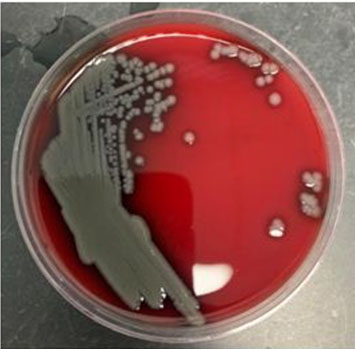
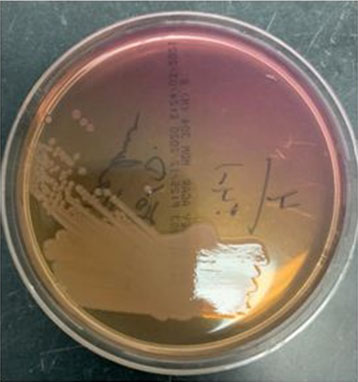
We screen him for malaria and dengue fever, and the report was negative. Also, we screen him for HIV and it was negative. Two sets of blood culture were positive for A. veronii (Figure 3 and Figure 4), and antibiotics changed upon sensitivity.
The patient was treated in Ophthalmology and Dermatology. Ophthalmology managed him with antibiotics eye drops with systematic intravenous (IV) antibiotics without any surgical intervention. It was a late presentation. A skin biopsy of the patient was taken in Dermatology, and the histopathological results were hemorrhagic subepidermal bullous, secondary to infection and the culture showed A. veronii.


Discussion
There are numerous Aeromonas species, few of them related to human extraintestinal infections [16].
More than 85% of Aeromonas-implicated clinical diseases are caused by the Aeromonas hydrophila, Aeromonas caviae, and A. veronii biovar sobria [17]. These infections are acquired in both community and hospital settings, and both immunocompetent and immunocompromised patients are susceptible. Aeromonas species can cause invasive and fatal infections in immunocompromised hosts and have been recognized as a serious threat to human beings [18]. Aeromonas veronii can cause infection ranging from skin to sepsis [19].
Sepsis is possibly the most relevant Aeromonas infection in terms of severity and frequency and is associated with several underlying diseases, especially immunocompromised or cancer patients [19].
In this case report, our patient was immunocompetent, and he did not receive any immunosuppressant medications. Although he developed sepsis in his eye, causing acute compartment syndrome with bilateral rupture globe, it is the first report for this organism to cause such complication.
Aeromonas species can carry and acquire antimicrobial resistance (AMR) elements, and presently multi-drug resistant (MDR). Aeromonas isolates are commonly found across the world. Aeromonas veronii strain MS-17-88 is an MDR strain isolated from catfish in the southeastern United States [20]. Our patient was initially managed with broad-spectrum antibiotics in the form of Vancomycin and Meropenem. The blood culture of two sets came with A. veronii, which is Carbapenem-resistant but, Ceftazidime sensitive. So, we changed the Meropenem to Ceftazidime. Still, unfortunately, the patient died the next day because of a septic shock.
Conclusion
Our case report highlights that infections caused by Aeromonas can lead to life-threatening clinical conditions and significant organ involvement like eye with laboratory alterations. The presence of infection from Aeromonas should also alert clinicians to the possibility of severe sepsis.
REFERENCES
1.
Tang HJ, Lai CC, Lin HL, Chao CM. Clinical manifestations of bacteremia caused by Aeromonas species in southern Taiwan. PLoS One 2014;9(3):e91642. [CrossRef]
[Pubmed]

2.
Parte AC. LPSN—list of prokaryotic names with standing in nomenclature. Nucleic Acids Res 2014;42(Database issue):D613–6. [CrossRef]
[Pubmed]
3.
Yu JH, Han JJ, Kim HJ, Kang SG, Park SW. First report of Aeromonas veronii infection in farmed Israeli carp Cyprinus carpio in Korea. Journal of Fish Pathology 2010;23(2):165–76.
4.
Janda JM, Abbott SL. The genus Aeromonas: taxonomy, pathogenicity, and infection. Clin Microbiol Rev 2010;23(1):35–73. [CrossRef]
[Pubmed]
5.
Chao CM, Gau SJ, Lai CC. Empyema caused by Aeromonas species in Taiwan. Am J Trop Med Hyg 2012;87(5):933–5. [CrossRef]
[Pubmed]
6.
Chao CM, Lai CC, Tang HJ, Ko WC, Hsueh PR. Biliary tract infections caused by Aeromonas species. Eur J Clin Microbiol Infect Dis 2013;32(2):245–51. [CrossRef]
[Pubmed]
7.
Chao CM, Gau SJ, Lai CC. Aeromonas genitourinary tract infection. J Infect 2012;65(6):573–5. [CrossRef]
[Pubmed]
8.
Lai CC, Ding LW, Hsueh PR. Wound infection and septic shock due to Aeromonas trota in a patient with liver cirrhosis. Clin Infect Dis 2007;44(11):1523–4. [CrossRef]
[Pubmed]
9.
Lai CC, Shiao CC, Lu GD, Ding LW. Aeromonas hydrophila and Aeromonas sobria bacteremia: Rare pathogens of infection in a burn patient. Burns 2007;33(2):255–7. [CrossRef]
[Pubmed]
10.
Lin WT, Su SY, Lai CC, Tsai TC, Gau SJ, Chao CM. Peritonitis caused by Aeromonas species at a hospital in southern Taiwan. Intern Med 2013;52(22):2517–21. [CrossRef]
[Pubmed]
11.
Chao CM, Lai CC, Tsai HY, et al. Pneumonia caused by Aeromonas species in Taiwan, 2004–2011. Eur J Clin Microbiol Infect Dis 2013;32(8):1069–75. [CrossRef]
[Pubmed]
12.
Chao CM, Lai CC, Tang HJ, Ko WC, Hsueh PR. Skin and soft-tissue infections caused by Aeromonas species. Eur J Clin Microbiol Infect Dis 2013;32(4):543–7. [CrossRef]
[Pubmed]
13.
Kimura M, Araoka H, Yoneyama A. Aeromonas caviae is the most frequent pathogen amongst cases of Aeromonas bacteremia in Japan. Scand J Infect Dis 2013;45(4):304–9. [CrossRef]
[Pubmed]
14.
Hossain S, De Silva BCJ, Dahanayake PS, Heo GJ. Characterization of virulence properties and multi-drug resistance profiles in motile Aeromonas spp. isolated from zebrafish (Danio rerio). Lett Appl Microbiol 2018;67(6):598–605. [CrossRef]
[Pubmed]
15.
Sun J, Zhang X, Gao X, Jiang Q, Wen Y, Lin L. Characterization of virulence properties of Aeromonas veronii isolated from diseased gibel carp (Carassius gibelio). Int J Mol Sci 2016;17(4):496. [CrossRef]
[Pubmed]
16.
Janda JM, Abbott SL. Evolving concepts regarding the genus Aeromonas: An expanding Panorama of species, disease presentations, and unanswered questions. Clin Infect Dis 1998;27(2):332–44. [CrossRef]
[Pubmed]
17.
Wu CJ, Chen PL, Hsueh PR, et al. Clinical implications of species identification in monomicrobial Aeromonas bacteremia. PLoS One 2015;10(2):e0117821. [CrossRef]
[Pubmed]
18.
Rhee JY, Jung DS, Peck KR. Clinical and therapeutic implications of Aeromonas bacteremia: 14 years nation-wide experiences in Korea. Infect Chemother 2016;48(4):274–84. [CrossRef]
[Pubmed]
19.
Igbinosa IH, Igumbor EU, Aghdasi F, Tom M, Okoh AI. Emerging Aeromonas species infections and their significance in public health. Scientific World Journal 2012;2012:625023. [CrossRef]
[Pubmed]
20.
Tekedar HC, Arick MA 2nd, Hsu CY, et al. Identification of antimicrobial resistance determinants in Aeromonas veronii strain MS-17-88 recovered from channel catfish (Ictalurus punctatus). Front Cell Infect Microbiol 2020;10:348. [CrossRef]
[Pubmed]
SUPPORTING INFORMATION
Author Contributions
Fatimah Alibrahim - Conception of the work, Design of the work, Drafting the work, Revising the work critically for important intellectual content, Final approval of the version to be published, Agree to be accountable for all aspects of the work in ensuring that questions related to the accuracy or integrity of any part of the work are appropriately investigated and resolved.
Abeer Moqebel - Conception of the work, Design of the work, Analysis of data, Drafting the work, Final approval of the version to be published, Agree to be accountable for all aspects of the work in ensuring that questions related to the accuracy or integrity of any part of the work are appropriately investigated and resolved.
Moneer Alaish - Conception of the work, Design of the work, Analysis of data, Drafting the work, Final approval of the version to be published, Agree to be accountable for all aspects of the work in ensuring that questions related to the accuracy or integrity of any part of the work are appropriately investigated and resolved.
Guaranter of SubmissionThe corresponding author is the guarantor of submission.
Source of SupportNone
Consent StatementWritten informed consent was obtained from the patient for publication of this article.
Data AvailabilityAll relevant data are within the paper and its Supporting Information files.
Conflict of InterestAuthors declare no conflict of interest.
Copyright© 2021 Fatimah Alibrahim et al. This article is distributed under the terms of Creative Commons Attribution License which permits unrestricted use, distribution and reproduction in any medium provided the original author(s) and original publisher are properly credited. Please see the copyright policy on the journal website for more information.